Viktor Hayes · 26 September 2026
Detecting Subtle Shifts in Content Flow Across Federated Networks
Federated networks distribute content through independent nodes that communicate via standardized protocols, and observers note that even minor alterations in these pathways can signal broader operational changes. Researchers track these patterns by measuring traffic volumes, latency variations, and endpoint response times across platforms that rely on systems like ActivityPub or similar decentralized architectures. Data collected from multiple nodes reveals how content originates at one server, propagates through relays, and reaches end users while maintaining consistency in delivery rates.
Core Metrics Used in Monitoring
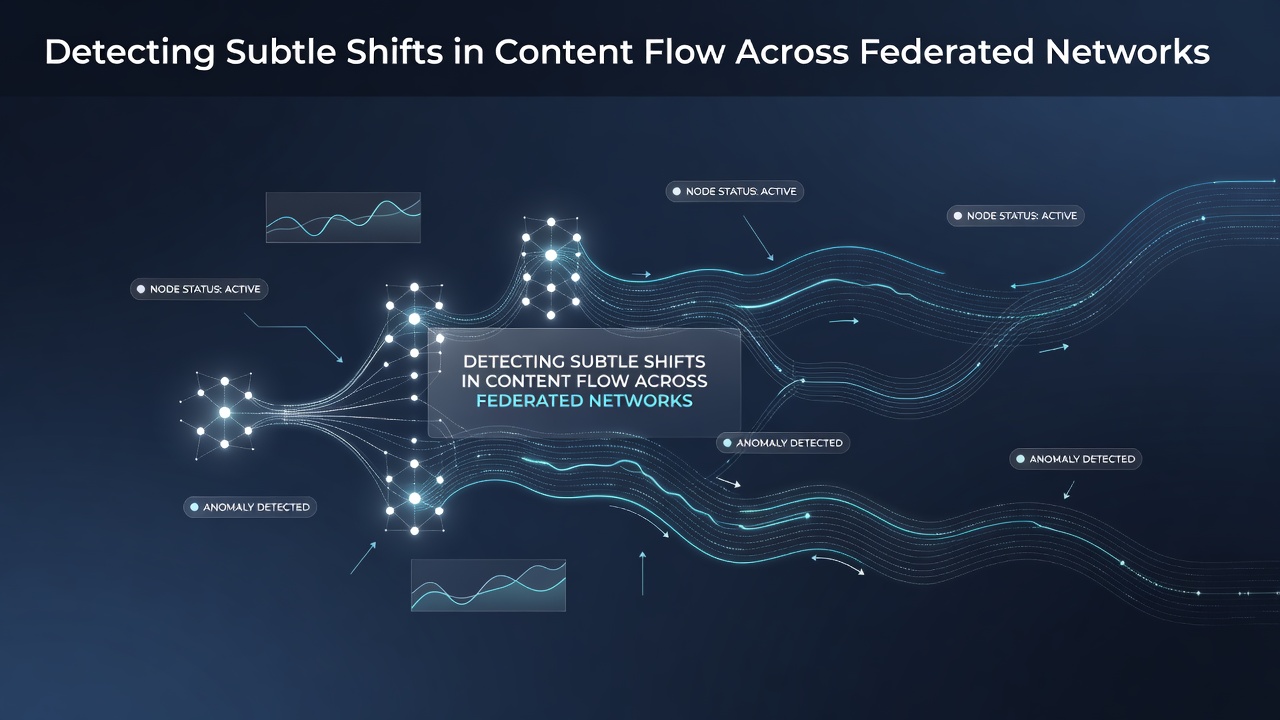
Analysts rely on several quantitative indicators to identify deviations, including packet arrival sequences, bandwidth allocation per node, and the frequency of content replication events. Studies conducted by academic teams show that baseline measurements established over extended periods allow for comparison against real-time feeds, highlighting anomalies such as unexpected drops in propagation speed or sudden spikes in cross-node queries. Those who examine these datasets often combine timestamp logs with graph-based visualizations to map relationships between participating servers, which helps isolate whether a shift stems from a single node or reflects network-wide adjustments.
Equipment deployed at key junction points collects continuous samples, and software processes these inputs to flag thresholds that exceed predefined tolerances. According to findings published by the European Union Agency for Cybersecurity, federated environments benefit from distributed logging frameworks that aggregate information without centralizing control, preserving the independent nature of each participant while enabling collective oversight.
Techniques Applied in Practice
One common approach involves anomaly detection algorithms trained on historical traffic data, which process incoming streams to detect outliers in content routing decisions. Engineers implement these models using statistical methods such as moving averages and deviation scoring, then validate results through manual review of affected node logs. In September 2026, monitoring reports indicated increased activity around protocol updates that altered how certain federated instances handled media attachments, prompting teams to refine their detection thresholds accordingly.
Another method employs simulation environments where controlled shifts are introduced to test system responsiveness. Observers record outcomes from these tests and apply the resulting patterns to live networks, adjusting parameters to improve accuracy. Teams at research institutions have documented cases where early identification of routing changes prevented widespread content duplication errors, maintaining service reliability across thousands of connected servers.

Integration with Existing Infrastructure
Organizations incorporate detection tools into their operational stacks by extending existing monitoring platforms rather than building standalone systems. This integration allows operators to correlate content flow data with security events and resource utilization reports, creating a unified view of network health. Reports from the Australian Cyber Security Centre highlight how such combined datasets assist in distinguishing between benign fluctuations caused by user behavior spikes and more significant structural modifications in the federation topology.
Configuration files define alert rules that trigger notifications when specific conditions appear, and administrators review these alerts alongside node status updates. The process supports both automated responses and human intervention, depending on the severity indicated by the collected metrics. Data from longitudinal studies demonstrate that consistent application of these practices leads to earlier recognition of emerging patterns across diverse geographic deployments.
Challenges Encountered During Implementation
Variability in node capabilities presents ongoing difficulties, as smaller instances may lack the computational resources to participate fully in advanced monitoring schemes. Coordinators address this by developing lightweight agents that perform local analysis and forward summarized results to shared repositories. Evidence from collaborative projects shows that standardization of data formats reduces friction when aggregating inputs from heterogeneous environments, although differences in protocol versions still require careful mapping.
Privacy considerations also influence how much detail can be shared between nodes, leading teams to adopt differential privacy techniques that obscure individual user activity while preserving aggregate flow statistics. Those managing large-scale federations report that balancing transparency with data protection requirements demands iterative refinement of collection policies over time.
Conclusion
Effective detection of subtle shifts in content flow depends on sustained measurement, algorithmic support, and coordinated responses across participating entities. Information gathered through these efforts informs maintenance decisions and helps sustain the stability of federated systems as they scale. Continued development of shared standards and analytical methods supports ongoing improvements in visibility without compromising the distributed principles that define these networks.